

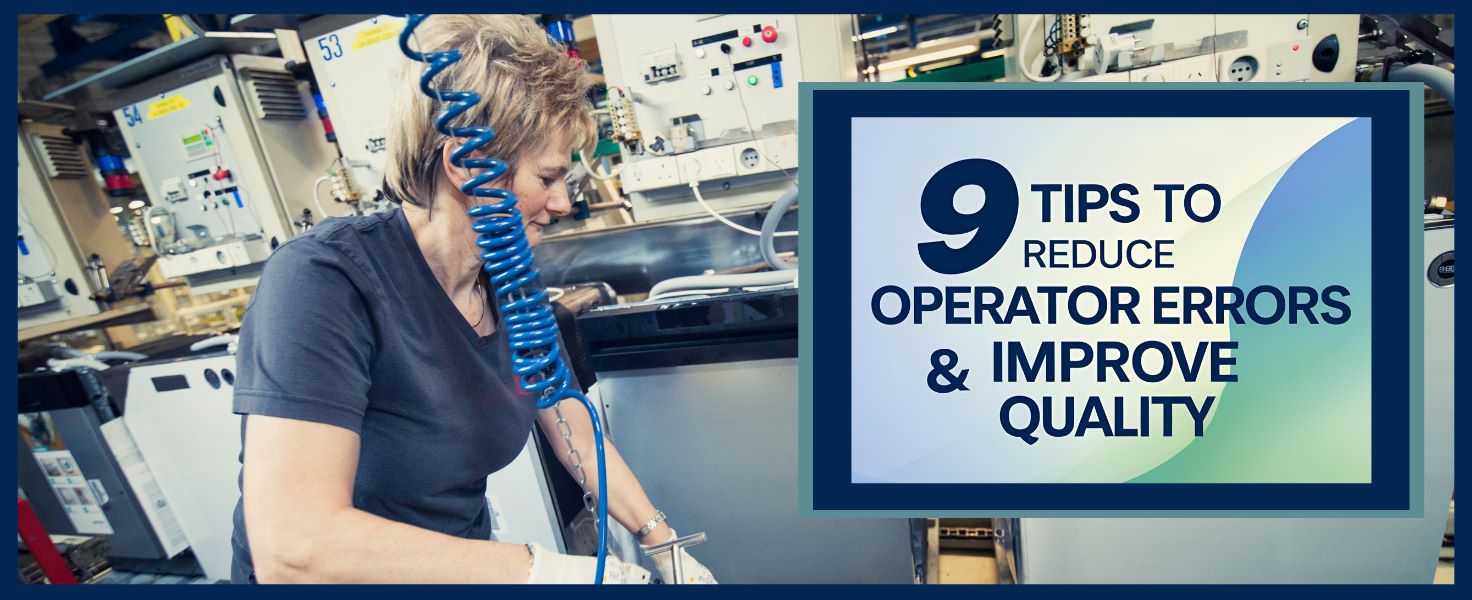
For the last three years, Matt Turner has been assembling control panels at a major manufacturer. The process is second nature, and he knows what to watch for. But, running short on sleep and near the end of his shift, Matt recently glanced at a posted SOP and didn’t bother with the checklist. He’d “done it a million times,” and everything looked fine.
Only later did the call come in: a customer had received a faulty unit, and the analysis traced back to a missed quality control step. Matt’s oversight was simple: a tired worker, a familiar task, a skipped step. Unfortunately, there was also an impacted customer.
In factories everywhere, stories like Matt’s play out more often than anyone would like. Even the most experienced workers are human and can make mistakes. But, do these errors have to occur?
Bottom line: Manufacturers can take errors down to zero or nearly zero. It’s not about perfect people; it’s about human-centered systems that provide a foundation for skills, rules, and knowledge.
Based on designing and implementing complex assembly processes since 1983, the following nine tips from Matrix Automation provide a quick overview of how to support operators, comply with standards and regulations, and reduce errors and risk.
1. Integrate Systems for Better Communication & Faster Response
Many plants still have a rat’s nest of disconnected systems on the plant floor, hindering communication. If your systems aren’t connected, problems can become bigger before they get caught.
Make sure you’re integrating across your your plant and eliminating those old islands of disconnection. You can share data across the plant, improve collaboration, and better support your operators with real-time notifications and guidance.
2. Simplify, Standardize & Digitize Work Instructions
Clear, simple instructions prevent confusion. If every shift uses the same step-by-step checklist for assembly, errors drop. At one auto parts plant, switching to digitized instructions reduced defects by 15%.
Furthermore, digital work instructions make updates easy and make sure everyone uses the latest version. Digital work instructions can interactively guide operators through the steps to take instead of relying on a stack of dated, static, paper-based manuals. Manufacturers can also build reminders and alarms right into the systems.
In the example above with Matt, a digital work instructions system could have enforced the quality check procedure, not allowing him to proceed without having completed the necessary previous steps.
Adam Jaworski, Manufacturing Engineer at Pride Mobility / Quantum Rehab, explained how digital work instructions from Matrix Automation reduced operator errors and training: “The electronic work instructions have assisted with cutting down operator training to a fraction of the time it was in the past. This ensures that all our operators are working to the same standards throughout the process. This also has cut down on operators’ mistakes to almost zero.” Get the full story on Pride Mobility.
3. Utilize Error-Proofing Tools Including Visual Aids
Error-proofing can span from simple signs and labels to sophisticated innovation such as pick and place with automated screens blocking incorrect bins.
Help workers with visual aids such as color coding, diagrams embedded in their digital work instructions, key PDFs at their fingertips, photos to support procedures, and more.
Matrix Automation has deep expertise in error-proofing. Discover more in our blog, Error-Proofing Assembly Manufacturing: Ensuring Production Precision and Quality.”
4. Foster a Culture of Continuous Improvement & Collaboration
Frontline workers know the process better than anyone else and can have the best ideas about how to reduce errors. Let operators know that you value their ideas and foster collaboration.
Have a regular rhythm for continuous improvement, reviewing processes and looking for ways to use Lean, improve quality, and ensure a better experience for customers.
A manufacturing solution can help teams have greater insight to support continuous improvement. Automotive tier 1 supplier, Woodbridge Group, saw this result from their manufacturing solution from Matrix Automation.
“The system has brought a new level of precision, efficiency, and transparency to our operations, allowing us to track production in real-time and optimize workflows,” said Jason Rhodes, Plant Manager at Woodbridge Group. “It has significantly reduced errors and downtime, enabling us to scale more effectively without compromising quality.” Explore the full Woodbridge case study.
With frontline workers, value even smaller ideas and concerns that the team brings forward. For instance, during a morning meeting, a line worker might point out a tool that’s wearing out. The supervisor can replace it before it causes an entire lot of flawed products. Thanking workers for ideas, even small ones, helps everyone take pride in their work and the company.
5. … and a Culture of Open, Constructive & Blame-Free Communication
Mistakes can happen. What matters is how the team responds. Team members can spot problems early if they feel comfortable speaking up. For example, if someone sees a mix-up with a batch of labels, letting the supervisor know right away keeps the problem small and gives the team a chance to make corrections. Open doors and honest talk help everyone feel like they’re on the same team.
6. Leverage Technology & Automation with a Human-Centered Design
Support your workforce with human-centered manufacturing solutions. Machines do the same task the same way, every time. Simple automation—such as a sensor that checks for missing screws—can catch mistakes before the product moves down the line. Some factories use barcode scanners to double-check that the right parts go into each box, reducing shipping errors by up to 30%.
Furthermore, a manufacturing solution from Matrix can document that the right parts and actions were taken. The system can automatically capture and store photos of final products, maintain a device history record for traceability, integrate with sensors and scanners, and more.
7. Conduct Informal & Formal Inspections
Even in today’s digital culture, management by walking around is still critical. A routine walkthrough, tablet or phone in hand, helps spot problems. If a loose guard is found on a machine, it gets fixed right away. These checks help keep the shop floor safe and stop small slip-ups from turning into big issues.
Also, they help foster the kind of culture that encourages discussion and improvement. Managers are taking time to be on the plant floor with the operators.
8. Provide Adequate Rest, Breaks & Training
Tired people make more mistakes. Giving workers time to step away from the line reduces errors and keeps everyone safer. In one busy factory, switching to shorter shifts cut missed parts by 20%.
Furthermore, comprehensive training is critical. When workers know their jobs well, they make fewer mistakes. For example, a new hire who practices machine setup with an experienced operator is less likely to forget a safety check. Regular training keeps everyone sharp. A short weekly refresher or team huddle can help catch small issues before they grow.
Automation can play a role in comprehensive training. Operators can train through simulation before moving onto the live production system, as one example. Digitization as discussed in Tip 2 also plays an important role. For more ideas on how to improve training, build workforce confidence, and increase operator retention, read our blog From Shaky to Sure.
9. Improve Ergonomics: Workstation Environments & Workflows
Arranging workstations and organizing tasks to fit the needs of workers can significantly cut down on mistakes. Simple ergonomic changes, like positioning frequently used tools within easy reach, minimizing unnecessary items, and creating user-friendly layouts, help people perform better and lower the risk of errors.
Working together, Matrix and the Woodbridge team look for ways to optimize manufacturing operations – and a big part of that is workflows. “Matrix is always proactive in identifying opportunities to improve and consistently provide expert guidance when we need it,” Rhodes concluded.
While these nine steps are simple, they are effective. Reducing worker errors keeps the factory running smoothly, saves money, and makes the job less stressful for everyone. When the team feels respected and prepared, quality naturally soars.