

How balancing assembly work across people and stations can improve flow, quality, and productivity
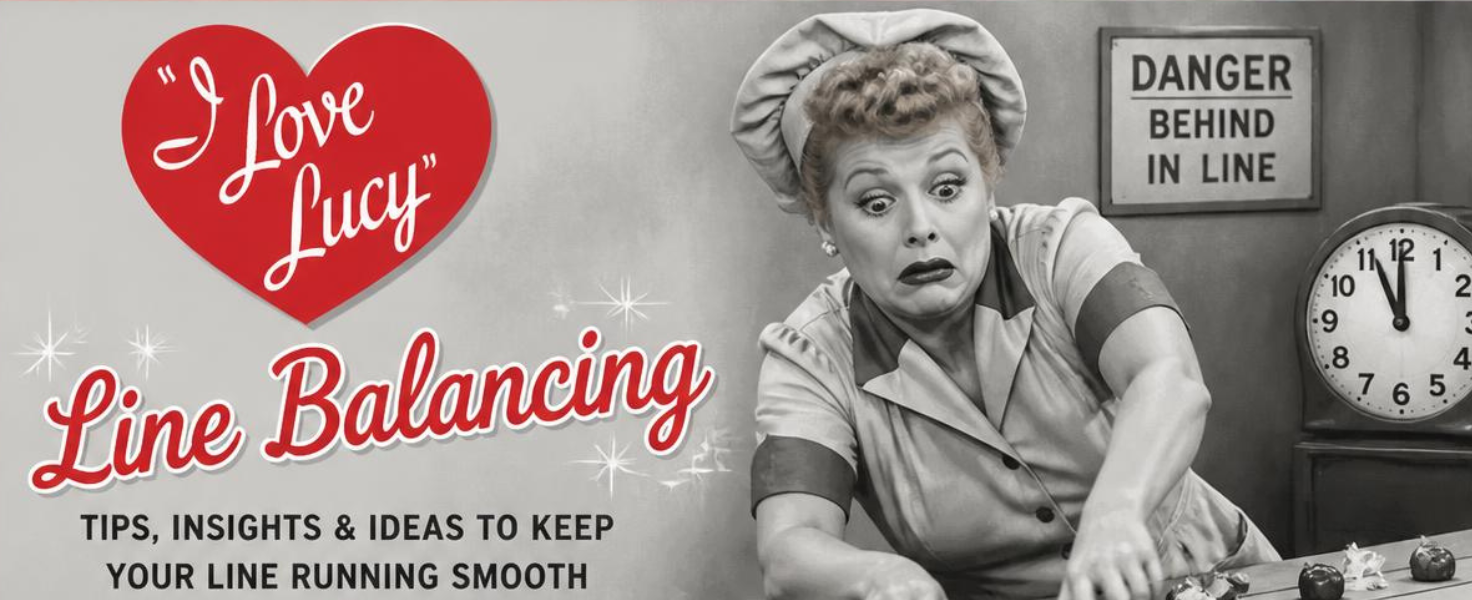
One of the most memorable scenes from I Love Lucy shows Lucy working on a chocolate factory line, trying desperately to keep up as candies move faster and faster down the conveyor. Chocolates pile up, and it’s funny.
In real assembly environments … it’s not so funny. One operator may be struggling to complete all of their assigned tasks within the available cycle time, while the operator at the next station has extra capacity. Parts begin to pile up between stations. Operators wait for work. Supervisors move people around to keep production moving. And by the end of the shift, the line is behind schedule.
This is where line balancing comes in – whether in automotive, HVAC, medical equipment, or other complex assembly.
Line balancing is the process of distributing work across operators and workstations so that production flows as evenly and efficiently as possible.
For human-centered assembly operations, effective line balancing can help manufacturers increase throughput, reduce waiting and bottlenecks, improve operator workloads, and create a more predictable production process.
What Causes an Unbalanced Assembly Line?
Assembly lines rarely stay perfectly balanced on their own. Changes in products, processes, staffing, and production requirements can all affect the flow of work.
Common causes of line imbalance include:
- Uneven task times: One station has significantly more work than others.
- Product variation: Different models or configurations require different assembly steps.
- Changes in staffing: Absences, turnover, or new operators can change station capacity.
- New products or processes: A new assembly process may add work to certain stations.
- Poor task distribution: Work may have been assigned based on how the line was originally designed rather than current production needs.
- Material availability: Operators may wait for parts, creating interruptions and uneven flow.
- Quality problems: Rework and defects can add unexpected work to certain stations.
- Manual processes: Paper instructions, disconnected systems, or inefficient processes can make some tasks take longer than necessary.
The result is often the same: some operators are overloaded while others are waiting.
Bottlenecks: The Problem at the Slowest Point
One of the most visible symptoms of an unbalanced line is a bottleneck, which occurs when one workstation (or more) cannot keep up with the required production rate. Work begins accumulating before that station, while downstream operators may eventually run out of work.
The natural response might be to tell the operator at a slower station to work faster. But that’s not necessarily the right answer. The better question is: Can the work be redistributed?
Perhaps one task can be moved to another station. Maybe two tasks can be reorganized. Maybe a digital work instruction can eliminate time spent searching for information. Perhaps an error-proofing solution can prevent a recurring mistake that causes rework.
Line balancing is about looking at the entire process, not simply asking individual operators to work faster.
Line Balancing Is About People, Not Just Numbers
Operators have different levels of experience. Some tasks are physically or cognitively more demanding than others. Product configurations can change the amount of work required at a station. And new operators may need additional time to learn a process.
Effective line balancing considers factors such as:
- Actual task times
- Operator experience and skill levels
- Product mix
- Production demand
- Ergonomics and physical workload
- Quality requirements
- Material presentation
- Rework
- Training requirements
- Available staffing
The goal is to create a sustainable flow of work – in reality, not just in planning.
Improving Line Balance with Automation
Modern manufacturing solutions can give manufacturers the data and visibility needed to understand what’s actually happening on the line and make smart adjustments.
Manufacturing Execution Systems: A Manufacturing Execution System (MES) can connect production activities and provide visibility into what is happening at individual workstations. Manufacturers can use production data to identify:
- Where production is slowing down
- How long tasks actually take
- Where operators are waiting
- Where rework is occurring
- Which stations are consistently behind
- How product variations affect cycle time
Instead of relying entirely on observations or assumptions, manufacturers can use actual production data to make better line-balancing decisions.
Digital Work Instructions: Digital work instructions can provide operators with the right instructions, images, and process information at the workstation. This can help reduce time spent searching for information and make processes more consistent. When task times improve or become more predictable, manufacturers have better information for balancing work across stations.
Digital instructions can also be updated when processes change, helping prevent outdated paper instructions from becoming a source of variation.
Error-Proofing: When an operator makes a mistake, the resulting correction or rework can add unexpected time to a workstation. Error-proofing can help prevent mistakes before they happen, making assembly processes more consistent and helping to keep work moving through the line.
Real-Time Production Visibility: Production requirements change. Products change. Operators change. Processes change. Real-time production visibility can help manufacturers identify when a previously balanced line starts becoming unbalanced. Supervisors and manufacturing teams can see where work is accumulating and investigate the underlying cause.
Line Balancing Is a Continuous Improvement Process
Line balancing works best as part of a broader continuous improvement strategy.
Manufacturers can continually analyze production data, identify constraints, redistribute work, improve processes, and measure the results.
The objective is to keep the entire line flowing. Better balance means better flow – and better flow can mean better productivity, quality, and performance.
Ready to improve line balance in your operations? Contact us and see how 40+ years of line balancing experience can help you identify bottlenecks, support operators, and keep complex assembly lines moving.