

Online reviews and complaint threads show how visible repair problems have become in the mobility industry. When a power chair, scooter, or other device breaks down, customers often emotionally and publicly describe the experience, naming the manufacturer and detailing long waits for parts, approvals, technician visits, or warranty repairs.
Reports and complaint examples point to repair delays that can stretch for weeks or even months, leaving people stranded without equipment they rely on every day.
For manufacturers, the impact goes beyond the direct warranty expense. Public complaints can damage brand trust, influence future buying decisions, increase pressure on dealers and service networks, and turn a repair issue into a larger reputation problem.
When Complex Assembly Becomes a Customer Problem
Manufacturers of mobility medical devices—including power wheelchairs, scooters, and other mobility systems—operate in one of the most demanding assembly environments in manufacturing today.
These products are highly configurable, mechanically complex, electronically sophisticated, and deeply personal to the people who rely on them every day. When something fails in the field, the impact goes far beyond a typical warranty claim. It can disrupt a customer’s independence, create costly service events, and damage long-term brand trust.
As the industry continues to face labor changes, product complexity, and rising customer expectations, many manufacturers are rethinking how assembly operations are managed on the plant floor.
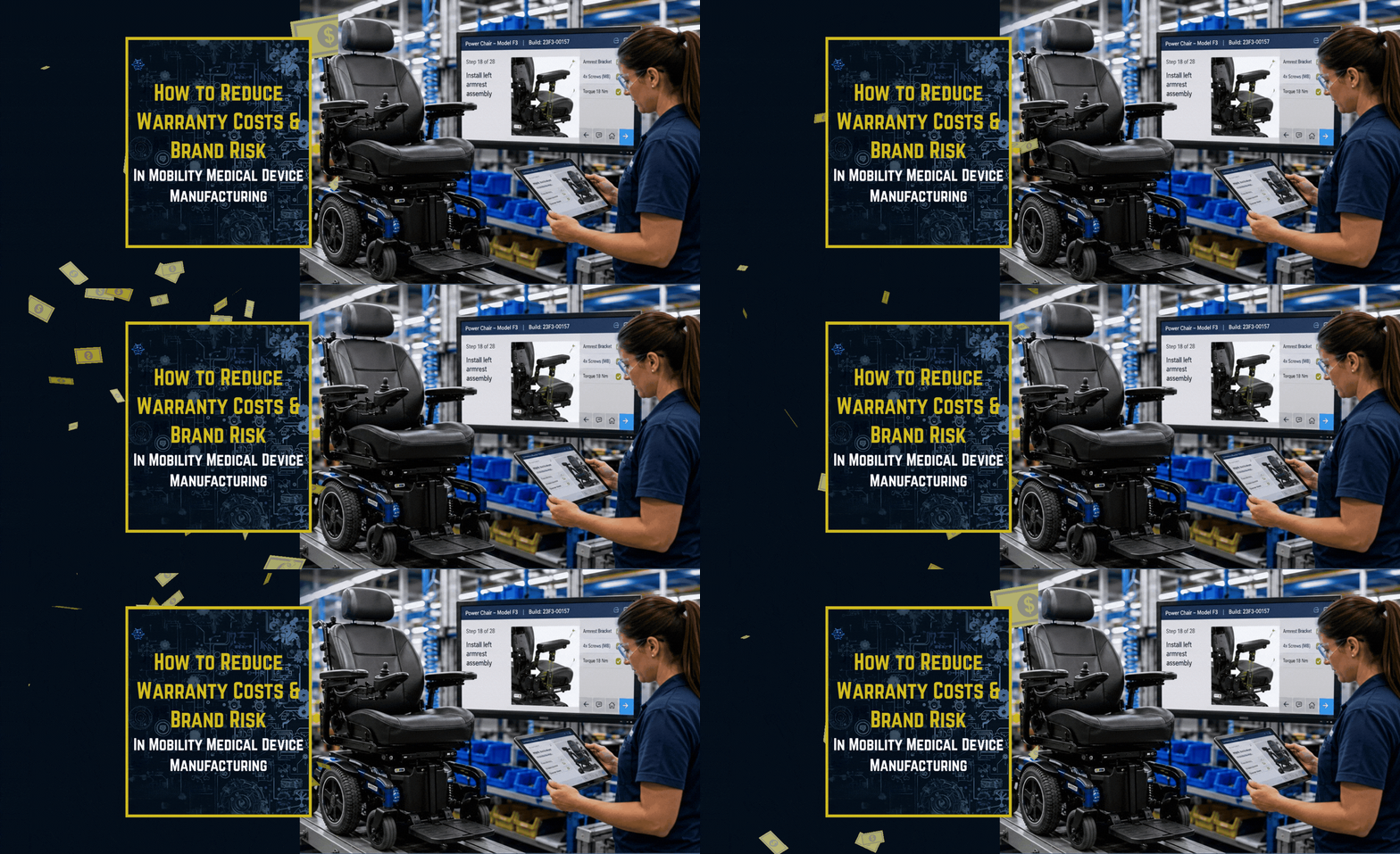
Increasingly, leading manufacturers are turning to modern digital manufacturing practices—including digital work instructions, error-proofing, manufacturing execution systems (MES), and real-time data capture and digital threads for traceability—to improve quality and reduce downstream warranty and repair costs.
Why Warranty Costs Are So High in Mobility Device Manufacturing
Complex durable medical equipment, such as power chairs and scooters, combines multiple systems into a single product such as mechanical assemblies, drive motors, batteries and charging systems, embedded electronics, wiring harnesses, seating systems, user-specific configurations, and safety-critical controls.
At the same time, many products are still assembled in highly manual production environments.
That combination creates significant operational challenges:
- High product mix variation
- Frequent configuration changes
- Operator-dependent processes
- Complex assembly sequences
- Traceability requirements
- Training challenges for new operators
Even small assembly errors can lead to expensive downstream consequences. Examples include: loose or improperly torqued fasteners, incorrect wiring connections, misconfigured controllers, improper battery installation, missing components, incorrect seating configurations, and harness routing issues.
Once products leave the factory, diagnosing and repairing these issues becomes dramatically more expensive than preventing them during assembly.
In many cases, the largest warranty costs are not replacement parts but field service labor, dealer coordination, repeat service visits, shipping and logistics, customer dissatisfaction, and brand reputation damage.
Pride Mobility turned to Matrix Automation to digitize its assembly processes. This has been a long-term partnership with benefits for Pride, its customers, and dealers. See the case study on Pride Mobility.
“Working with Matrix Automation over my career has been a very positive experience. Their team always goes above and beyond when we need assistance with issues on our line or to develop new commands. They do this all with a professional and friendly attitude.”
David Breese, Manufacturing Engineer, Pride Mobility
Moving From Reactive Quality to Built-In Quality
Traditionally, many manufacturers relied heavily on end-of-line inspection to catch problems before shipment.
But final inspection alone is rarely enough for complex configurable products.
Modern manufacturers are instead focusing on “built-in quality”—creating systems that help operators perform assemblies correctly the first time while preventing defects from moving downstream.
This is where digital manufacturing technologies can provide measurable value.

Digital Work Instructions Reduce Human Error
Paper work instructions often struggle to keep pace with the complexity of modern mobility device manufacturing.
Products may have hundreds of configuration combinations, frequent engineering updates, customer-specific build requirements, and specialized accessory options.
Digital work instructions help manufacturers ensure operators always see the correct process for the exact product being assembled.
Modern systems guide operators through each step with clear visual instructions. They can validate work in real time and present images, PDFs, and other resources when extra clarity is needed. They can also control task sequence automatically and keep instructions updated by revision. Some platforms also provide training support tailored to the operator.
This approach is especially helpful when new employees are learning the process. It also supports high-mix production and custom configurations, where the correct steps can vary from one unit to the next. The same tools are valuable in complex electrical and mechanical assemblies, where consistency matters at every station.
Rather than relying solely on tribal knowledge or memory, operators are supported directly within the assembly process.
Error-Proofing Helps Prevent Costly Field Failures
Error-proofing—or poka-yoke—is one of the most effective ways to reduce warranty issues before they happen.
In mobility device manufacturing, error-proofing often starts with verifying critical assembly steps. Teams may connect torque tools so tightening is confirmed automatically. They may also use barcode scans and presence checks to confirm the right parts are installed. For electrical and mixed assemblies, connector validation and scan-and-verify steps help prevent mistakes before the unit moves forward. Some operations add pick-to-light guidance and automated test validation to strengthen control at the workstation.
Instead of discovering a defect after shipment, manufacturers can catch issues immediately at the workstation. That means less rework on the line and fewer defects escaping into the field. It also helps lower warranty claims, reduce service dispatches, and limit recall exposure.
For products where reliability and safety are critical, preventing assembly variation is essential.
Find out how error-proofing and digital assembly from Matrix Automation has helped Invacare America. Explore the case study.
Matrix Automation has helped our manufacturing team: error-proof our processes, improve our process quality, meet regulatory requirements, and improve throughput. If it wasn’t for the Matrix solution, I don’t think Invacare would still be in the power chair business.
Ron Tucker, Director of Quality, Invacare America
MES Systems Improve Flow and Visibility
Manufacturing execution systems (MES) play an important role in improving both quality and operational efficiency.
Many mobility products move station-to-station on carts or flexible assembly lines. Production schedules change frequently, and operators may build multiple product variants in the same shift.
MES platforms help manufacturers manage this complexity by providing:
- Real-time production visibility
- Workstation tracking
- Line balancing
- Labor visibility
- In-line testing management
- Digital genealogy and traceability
- Dynamic work routing
- Quality management and data collection
Line balancing is especially important in manual assembly environments.
When certain stations become overloaded, operators may rush work, skip verification steps, or create bottlenecks that increase quality risk.
Among other benefits, MES systems help manufacturers better distribute work content across stations while identifying areas where additional support or process improvements may be needed.
Supporting Operators Is a Competitive Advantage
One of the most overlooked aspects of modern assembly practices is operator support.
Manufacturing labor remains one of the industry’s biggest challenges: high turnover, training gaps, increasing product complexity, and loss of experienced tribal knowledge.
Modern digital systems help reduce cognitive load on operators by guiding processes clearly and consistently. This helps skilled workers succeed.
The result is often:
- Faster training
- Improved first-pass yield
- Reduced rework
- Lower stress on operators
- More consistent product quality
In industries where assembly quality directly impacts customer mobility and safety, operator support becomes a strategic advantage.
Go Paperless Now
As mobility products continue evolving with more electronics, connectivity, customization, and advanced features, assembly complexity will continue increasing.
Manufacturers that rely solely on paper processes and manual quality controls will struggle to keep pace.
With decades of experience in this industry, Matrix Automation and our solutions for mobility medical device manufacturers have improved assembly quality, operator guidance, and manufacturing process visibility. Ready to learn more? Contact us to find out how we can overlay modern manufacturing into your complex assembly, decreasing warranty costs and protecting your brand.