

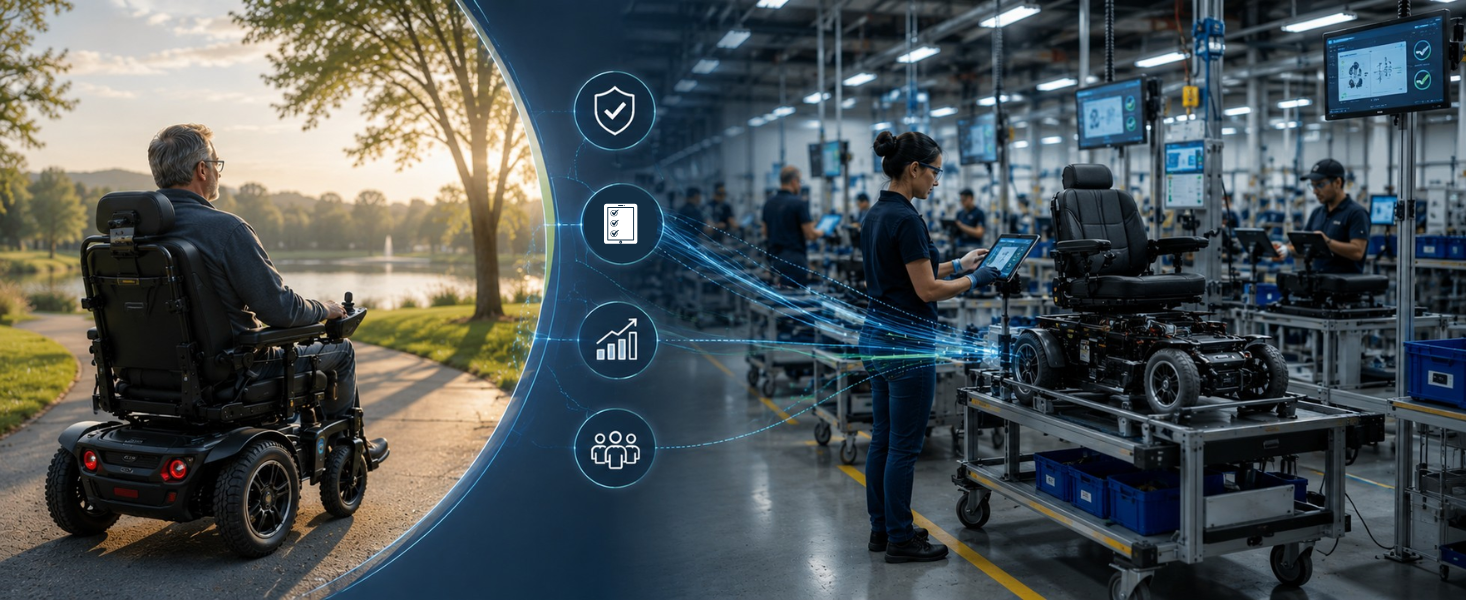
Power wheelchairs, mobility scooters, and other mobility products are highly configurable, assembled primarily by people, and built in environments where quality and reliability are critical. At the same time, manufacturers must increase throughput to meet demand, onboard new employees quickly, maintain compliance, and control costs.
In this environment, assembly errors create more than just quality problems. They slow production, consume valuable labor resources, and reduce profitability.
The costliest assembly mistake is often the one that moves quietly down the line—until it shows up as rework, delay, or a missed shipment.
Error-proofing gives mobility medical device manufacturers a way to catch those issues before they become production problems.
The Hidden Cost of Assembly Errors
When manufacturers think about assembly errors, warranty claims and costs often come to mind first. However, the largest costs typically occur long before a product ever reaches a customer.
Consider a common scenario on a mobility device assembly line. An operator installs an incorrect component, misses a configuration requirement, or skips a required assembly step.
The result may not be discovered until final testing or inspection.
Now the product must be pulled aside, diagnosed, repaired, retested, and reintroduced into production. Additional labor is required, production schedules are disrupted, and valuable floor space becomes occupied by rework inventory.
In many cases, the biggest impact is the disruption to throughput and inability to meet order demands. For manufacturers focused on increasing production capacity, reducing assembly errors is one of the most effective ways to improve operational performance.
“Matrix Automation has helped our manufacturing team: error-proof our processes, improve our process quality, meet regulatory requirements, and improve throughput. If it wasn’t for the Matrix solution, I don’t think Invacare would still be in the power chair business.”
Ron Tucker, Director of Quality, Invacare America. Get the full Invacare America case study.
Why Error-Proofing Matters in Mobility Device Manufacturing
Unlike highly automated industries, mobility device manufacturing remains largely human-centered.
Products are often assembled on carts or mobile workstations as they move between operators. Multiple customer configurations may be built on the same production line. New employees frequently need to learn complex assembly procedures while maintaining production targets.
This creates numerous opportunities for errors, including:
- Incorrect component installation
- Missed assembly steps
- Configuration mistakes
- Incomplete inspections
- Documentation gaps
- Testing and verification issues
Traditional approaches such as paper-based work instructions, checklists, and supervisor oversight can help, but they often struggle to keep pace with product complexity and engineering changes.
Modern error-proofing provides a more effective solution.
What Is Error-Proofing?
Error-proofing is the practice of designing manufacturing processes that help prevent mistakes before they occur or identify them immediately when they happen.
Rather than relying solely on operator memory or experience, error-proofing systems provide guidance, validation, and process control throughout assembly.
The goal is simple: Build quality into the process instead of trying to inspect quality into the product later.
Digital Work Instructions: Supporting Operators at Every Step
One of the most effective error-proofing tools available today is digital work instructions.
Unlike paper-based instructions that can become outdated or difficult to follow, interactive digital work instructions provide real-time guidance based on the specific product being assembled.
“The electronic work instructions [from Matrix] have assisted with cutting down operator training to a fraction of the time it was in the past. This ensures that all our operators are working to the same standards throughout the process. This also has cut down on operator’s mistakes to almost zero.”
Adam Jaworski, Manufacturing Engineer, Pride Mobility. Explore the Pride Mobility case study.
Operators receive clear, step-by-step instructions that can include:
- Photos and other visual aids
- Product-specific assembly requirements
- Quality checkpoints
- Inspection criteria
- Required process verifications
Digital work instructions help reduce variability between operators while making it easier for new employees to become productive quickly.
Most importantly, they provide operators with the information they need exactly when they need it.
MES: Creating Process Control Across Production
While digital work instructions guide operators, a Manufacturing Execution System (MES) helps ensure the entire assembly process is executed correctly.
MES acts as the operational backbone of the production environment by managing workflows, validating process completion, and collecting production data.
For mobility device manufacturers, MES can help:
- Verify and record that required assembly steps are completed
- Ensure the correct product configuration is being built
- Capture quality and test data
- Track component and product genealogy
- Manage inspections and audits
- Provide real-time visibility into production performance
- Prevent non-conforming products from advancing through production
Together, digital work instructions and MES create a closed-loop error-proofing system that helps improve both quality and throughput.
How Error-Proofing Improves Throughput
Many manufacturers initially view error-proofing as a quality initiative. In reality, it is often a productivity initiative as well.
When assembly errors decrease:
- Less time is spent on rework
- Fewer products require troubleshooting
- Final testing becomes more predictable
- Production schedules become more stable
- Operators spend more time building products and less time fixing problems
As a result, manufacturers can often increase throughput without adding headcount or expanding production space. Simply put, fewer mistakes mean more products shipped.
Improving KPIs with Error-Proofing
Improved First-Pass Quality: By guiding operators and validating process completion, manufacturers can reduce defects and improve consistency across shifts and production lines.
Faster Operator Training: Digital guidance reduces dependence on tribal knowledge and helps new employees become productive more quickly.
Better Traceability: Electronic records provide visibility into what was built, who built it, which components were used, and what quality checks were performed.
Greater Process Consistency: Standardized digital processes help ensure that every product is assembled according to the latest engineering and quality requirements.
Reduced Warranty Exposure: When products are built correctly the first time, quality issues are less likely to reach the customer. This reduces warranty claims, service costs, and field repairs.
Building Quality into the Process
Mobility medical device manufacturers improve quality by helping operators do the right work, in the right sequence, with the right information.
With modern error-proofing, the result is a more controlled, efficient production environment where products move faster, defects decrease, and operators are set up to succeed.
Want to learn more? Contact us to explore how Matrix Automation can help you build error-proofing directly into your assembly process.