

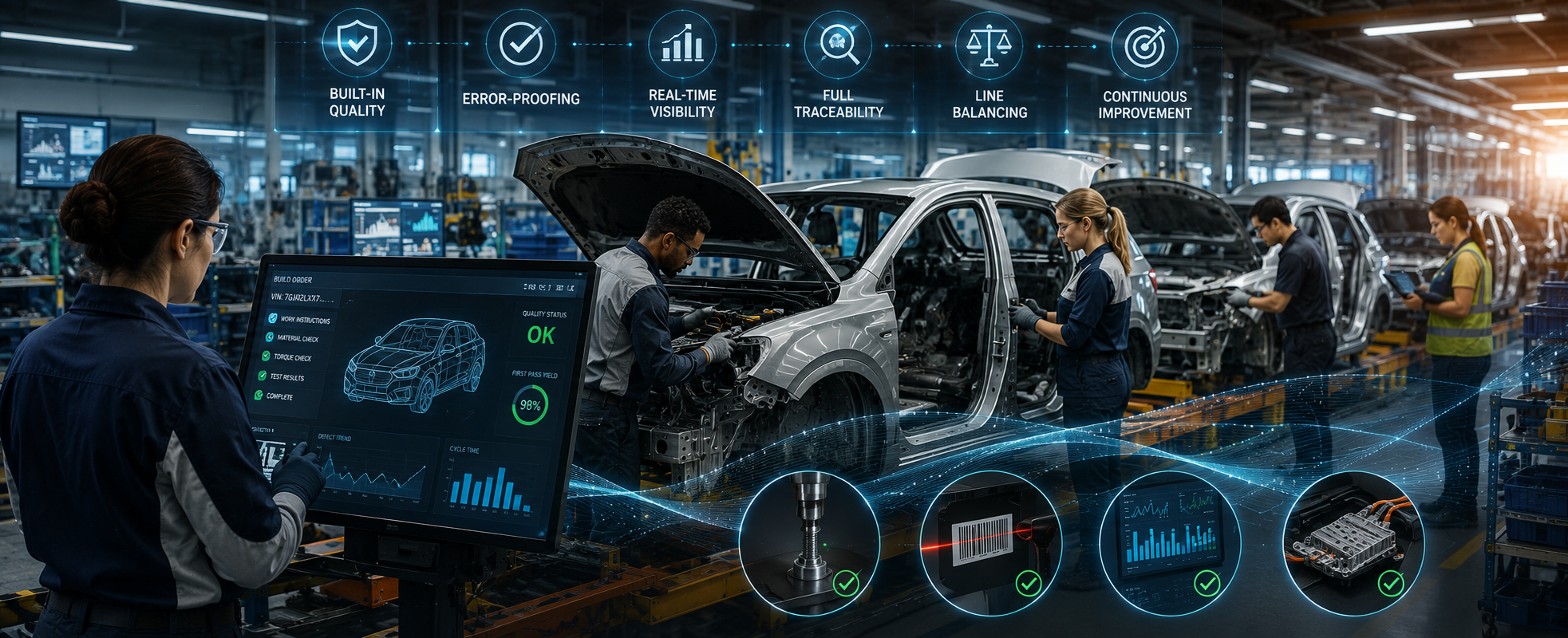
Quality should never take a back seat in automotive supplier assembly—especially when every seat, instrument panel, wiring harness, battery, HVAC module, steering column, and door module must leave the plant built right the first time.
For automotive suppliers, a single escaped defect can trigger costly rework, customer line stoppages, warranty exposure, chargebacks, and reputational damage. Improving quality takes standardized processes, digital manufacturing systems, real-time controls, and operator guidance working together to build quality into every assembly before it ships.
Matrix Automation has 40+ years of experience in automotive assembly solutions, Tier suppliers rely on our quality and execution expertise to reduce operator errors and improve results. Explore our case studies booklet to see how.
Here are eight proven strategies to improve quality in automotive assembly.
1. Standardize Every Assembly Process.
Quality begins with consistency.
Even highly skilled operators can introduce variation when work instructions are incomplete, outdated, or interpreted differently from shift to shift. Standardized work with digital work instructions reduces variability and ensures every operator performs each task the same way.
Many automotive tier suppliers are replacing paper instructions with digital work instructions that:
- Display the correct instructions for the specific part number, customer, or build order
- Automatically update engineering changes
- Include photos, other visual aids, and documents
- Verify critical assembly steps before operators can continue
- Capture completion data for traceability
Standardized digital processes can help ensure every assembly or subassembly is built according to the latest engineering specifications and customer requirements.
2. Error-Proof the Assembly Process.
The most effective quality strategy is preventing defects instead of detecting them later. Error-proofing (poka-yoke) can help eliminate opportunities for mistakes before they become costly problems.
“I have been working with Matrix’s error-proofing application for years with several different vehicle platforms and have had great success,” said Scott Trombley, Senior Process / Manufacturing Engineer, FORVIA, a leading automotive Tier 1 supplier. Get the full story on FORVIA here.
“It is relatively easy to use and very user friendly when it comes to upgrading for engineering changes and revisions that bump part numbers to the next level. Also, Matrix is very customer driven. The staff make themselves available at all hours of the day and night.”
Some error-proofing examples include:
- Verifying the correct parts before installation
- Confirming torque tools meet specifications
- Preventing incorrect sequence of operations
- Validating variant content for each assembly
- Detecting missing or incorrect components
- Automatically quarantining suspect assemblies
Rather than depending solely on operator memory, error-proofing systems actively guide production and stop defects before they move downstream to the OEM or next-tier customer.
3. Get Connected and Smarter with a Manufacturing Execution System (MES).
Many quality problems occur because production information is scattered across multiple systems.
A Manufacturing Execution System (MES) connects people, machines, equipment, testing stations, ERP systems, and quality systems into a single production workflow. An MES can:
- Manage production orders
- Deliver the correct work instructions
- Track production status in real time
- Verify process completion
- Collect production and quality data
- Maintain complete genealogy for every assembly
- Provide full product traceability
Instead of relying on disconnected spreadsheets or paper records, tier suppliers gain a single source of truth for production and quality across every assembly line.
Our customers say it best, hear from Scott Wolbers with 30+ years of Plant Management at Woodbridge Group, a leading Tier 1 supplier, discuss how an MES solution from Matrix Automation improved the company’s manufacturing – leading to “perfection.”
4. Perform In-Line Quality Verification.
Finding defects at final inspection is expensive. If you’re not preventing 100% of errors, then finding them immediately after they occur is much less costly. Automotive Tier suppliers increasingly perform in-line verification throughout assembly rather than waiting until the end of the line. Examples include:
- Leak testing
- Functional testing
- Electrical testing
- Vision inspection
- Barcode verification
- Torque verification
- Presence detection
- Software validation
When problems are detected immediately, manufacturers can contain issues before additional value is added to defective products and before nonconforming assemblies are shipped to customers.
5. Improve Line Balancing.
Quality and productivity often go hand in hand. Poorly balanced assembly lines create bottlenecks, operator stress, rushed work, and inconsistent quality. Line balancing helps ensure that:
- Workloads are evenly distributed
- Operators have sufficient cycle time
- Production flows smoothly
- Overtime and fatigue are reduced
- Quality isn’t sacrificed to maintain throughput
Digital production systems also provide visibility into bottlenecks, so Tier suppliers can continuously improve line performance and maintain stable output for customer demand.
6. Capture Data That Supports Root Cause Analysis.
Every production line generates valuable information, but only if it’s captured and analyzed. Automotive Tier suppliers can collect real-time production data including:
- Defect trends
- Cycle times
- Equipment performance
- Test results
- Operator activity
- Rework history
- Material usage
- Downtime events
This information allows quality teams to identify recurring issues, uncover root causes, and implement corrective actions based on facts rather than assumptions.
Instead of asking, “Why did this happen?” after a customer complaint or audit finding, manufacturers have the production history needed to proactively perform root cause analysis and optimize.
7. Build Complete Traceability.
Assembly complexity continues to increase, making traceability more important than ever. Complete genealogy allows Tier suppliers to know:
- Which operator built each assembly
- Which components were installed
- Which lot numbers were used
- Which torque values were recorded
- Which tests were performed
- Which software version was loaded
- Which equipment completed each operation
This level of traceability simplifies audits, accelerates investigations, supports warranty analysis, and limits the scope of containment if quality issues arise at the OEM or in the field.
8. Create a Culture of Continuous Improvement.
It takes more than technology to improve quality. The best automotive Tier suppliers combine digital manufacturing tools with Lean manufacturing principles and continuous improvement for a modern Digital Lean or Lean 2.0 approach.
Real-time production data helps teams:
- Identify recurring losses
- Eliminate waste and minimize costs
- Reduce operator variation
- Improve standard work
- Optimize production flow
- Increase first-pass yield
By continuously measuring and improving processes, manufacturers build a culture where quality becomes part of every operation, not just the responsibility of the quality department.
Improving Quality Requires an Integrated Approach
Tier suppliers achieve the greatest improvements when digital work instructions, Manufacturing Execution Systems (MES), error-proofing, traceability, in-line testing, production analytics, and Lean manufacturing work together as an integrated production system.
Instead of reacting to defects after they occur, manufacturers can prevent problems before they happen, improve first-pass quality, reduce warranty costs, and achieve on-time, in-sequence production.
At Matrix Automation, we’ve spent more than four decades helping automotive Tier suppliers build quality at the source. The goal is simple: help manufacturers reduce operator errors, improve production efficiency, and consistently build high-quality assemblies the first time.
Ready to learn more? Explore proven automotive supplier solutions from Matrix Automation or contact us today to level up with digitization and smart manufacturing.