

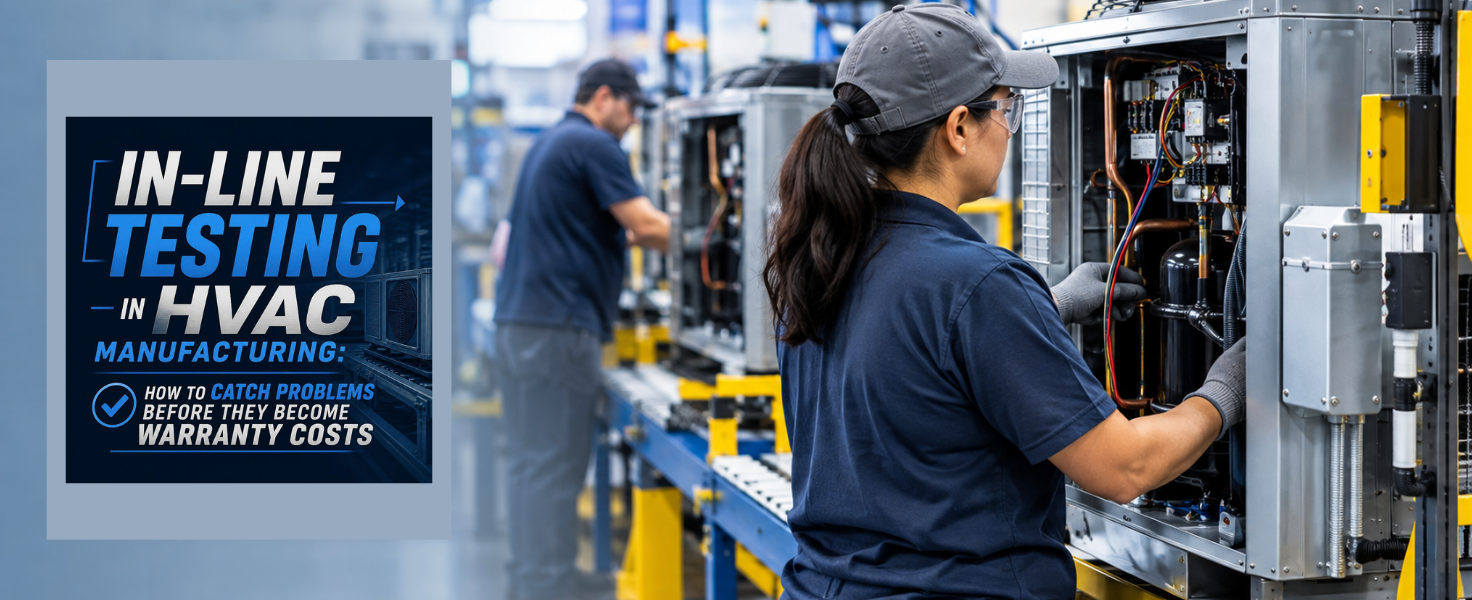
Every defect caught on the HVAC assembly line is one less warranty claim waiting to happen. In-line testing verifies critical connections, components, electrical systems, and refrigerant charging while equipment is still being built. This helps manufacturers prevent rework, field service calls, dissatisfied customers, and unnecessary costs before problems leave the plant.
For Matrix Automation, in-line testing is part of a broader approach to smarter, more controlled HVAC assembly. Testing can be connected to the product’s bill of materials, operator instructions, error-proofing, serial number, and production data through a manufacturing solution.
What Is In-Line Testing?
In-line testing is the practice of testing a product or assembly at specific points during the manufacturing process. The tests are performed as part of the normal production workflow rather than as a separate inspection after assembly is complete. For HVAC manufacturers, that can include electrical and functional checks such as:
- Hi-Pot testing
- Voltage checks
- Control power verification
- Unit power checks
- Contactor and pin checks
- Starting tests
- Refrigerant charging and monitoring
- Leak detection
- Other product- or model-specific tests
The exact tests depend on the equipment being manufactured and the manufacturer’s quality requirements. The important point is that the test becomes part of the production process, and the results can be captured, tracked, and associated with the individual unit.
Catch Problems Earlier
When a test is performed immediately after a critical assembly step, problems can be identified while the product is still at the station. That gives operators and manufacturing teams an opportunity to address the issue before the unit moves farther down the line. The result is less downstream rework and less risk of passing a defect to the next operation.
Make Sure Required Tests Actually Happen
Testing only helps if the required test is performed. A manufacturing execution system (MES) can enforce required tests based on the product’s model or serial number. At York International, for example, Matrix’s system enforces required in-line tests including Hi-Pot, voltage checks, and other tests. Read the full case study on York International.
This creates a controlled process instead of relying solely on memory, paperwork, or manual checklists.
Connect Test Results to the Product
Capturing test results by serial number creates a record of what happened during production. York’s Matrix system tracks testing and inspection results by serial number and provides detailed test data for diagnostics, analysis, and traceability. That information can help manufacturers investigate defects, identify recurring problems, support quality initiatives, and understand what happened with a specific unit.
Give Operators Better Information
In-line testing shouldn’t simply tell an operator that something failed. It should help the operator understand what happened and what to do next. At York, the Production Controller displays test status and current parameters. When a test step fails, the system provides information about the failure and predicted causes. That turns testing into an active part of the operator’s workflow.
In-Line Testing + Error-Proofing = Stronger Quality Control
Testing becomes even more powerful when it is connected to error-proofing. Consider a typical HVAC assembly process. A unit may require the correct components, tools, assembly steps, electrical connections, and tests. An MES can help control that process from the beginning.
For York, Matrix’s system manages assembly from the bill of materials and guides operators through the required steps. It can verify components, verify tools, enforce required tests, and manage rework. This creates multiple opportunities to prevent or catch errors:
Use the right part → perform the right assembly step → use the right tool → perform the required test → capture the result.
Instead of treating quality inspection as something that happens after manufacturing, quality becomes embedded in the manufacturing process.
Refrigerant Charging: Precision Matters
In-line testing and process control can also help manufacturers manage refrigerant charging. At York, the Matrix system integrates with the PLC to control charging to a precise target amount. The system monitors refrigerant levels and checks that they remain within expected parameters for each unit. This provides another example of how manufacturing data and equipment integration can support both quality and efficiency.
York reported that the system helped use less refrigerant overall by reaching the target amount quickly and efficiently, reducing material cost and waste.
The Value of Testing Goes Beyond Pass or Fail
One of the biggest advantages of connected in-line testing is the amount of production information it can generate. A simple pass/fail result tells you whether a unit passed a particular test. Connected manufacturing data can tell you much more. For example, York’s system provides station-level statistics including:
- Passed, failed, and aborted tests
- Takt time
- Target time
- Average time
- Last unit time
It also captures detailed diagnostic test information. The information can help manufacturing teams look beyond individual defects and identify patterns.
- Are failures concentrated at one station?
- Is a particular test producing more failures than expected?
- Is a process taking longer than its target time?
- Are problems occurring with a particular model?
The answers can support continuous improvement efforts and help teams address problems at their source.
For HVAC manufacturers looking to improve quality, reduce rework and warranty costs, and gain better visibility into production, in-line testing can be an important part of a smarter assembly strategy.
Looking to strengthen quality on your HVAC assembly line? Let’s talk about your assembly process and where in-line testing could make a difference.