

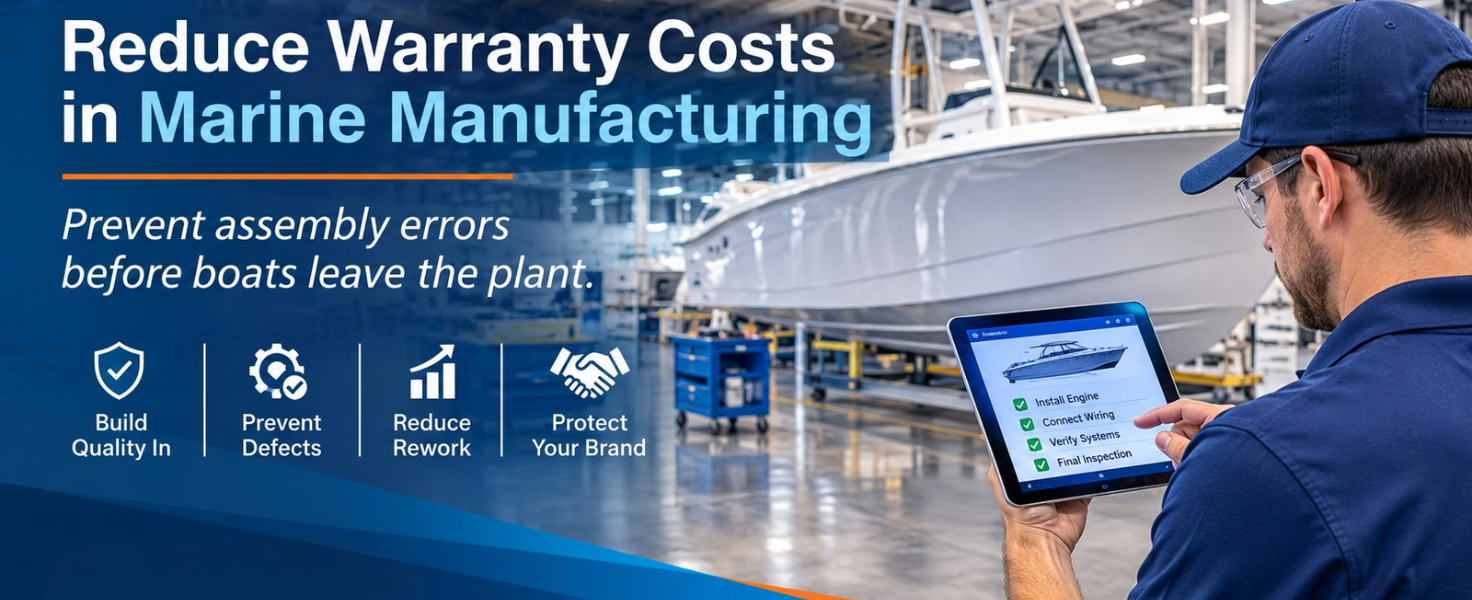
Preventing Assembly Errors Before Boats Leave the Plant
In recreational boat manufacturing, quality doesn’t end when a boat rolls off the production line. It gets tested on the water.
A wiring issue, improperly installed component, missed connection, or incorrect configuration can quickly become a costly warranty claim. And the expense goes well beyond the replacement part. There is service labor, dealer coordination, troubleshooting, and the potential impact on customer satisfaction and brand reputation.
For manufacturers of recreational power boats, reducing warranty costs starts on the factory floor.
Many marine manufacturers still rely on paper-based work instructions, printed build sheets, and the experience of skilled operators to manage complex assembly processes. These legacy methods can work, but they make it difficult to ensure every step is completed correctly, especially when boats are highly customized.
Digitizing work processes and incorporating error-proofing into assembly can help manufacturers catch problems before they become warranty issues.
Why Assembly Errors Lead to Warranty Costs
Building a recreational boat involves hundreds of individual assembly tasks. Depending on the model and customer configuration, these may include installing engines, routing electrical wiring, connecting plumbing, mounting electronics, and completing interior and exterior finishes.
Boat building often involves a high mix of models, options, and customer-specific configurations. Two boats of the same model may have different engines, electronics packages, seating arrangements, and accessories.
That flexibility is important, but it also creates opportunities for mistakes.
Common sources of assembly errors include:
- Incorrect components: The wrong part or accessory is installed for a particular configuration
- Missed steps: A connection, fastener, or inspection task is overlooked
- Outdated instructions: Operators work from printed documents that don’t reflect the latest engineering changes
- Inconsistent processes: Different operators perform the same task differently, relying on individual experience rather than standardized procedures
Some problems are caught during final inspection. Others may not surface until the boat reaches the dealer or customer. By then, the cost of correcting the issue can be significantly higher.
1. Replace Paper Instructions with Digital Workflows
One of the most effective ways to reduce assembly errors is to give operators clear, accurate instructions at the point of work.
Digital Work Instructions replace static paper documents with step-by-step guidance available on a tablet at the workstation. Instructions can include visual references, assembly procedures, parts information, and required quality checks.
For manufacturers building customized boats, instructions can be tailored to the specific model and configuration. Operators see the steps relevant to that build rather than sorting through paperwork for multiple models and options.
When engineering makes a change, digital instructions can be updated and made available to the production team. This reduces the risk of outdated information being used on the shop floor. The result is more consistent assembly, fewer opportunities for mistakes, and less dependence on tribal knowledge.
2. Build Error-Proofing into Assembly
Digital instructions help operators know what to do. Error-proofing helps ensure the work is done correctly. Also known as poka-yoke, error-proofing uses process controls and verification steps to prevent mistakes or identify them before they move downstream.
For recreational boat manufacturers, this can include:
- Component verification: Confirm engines, electronics, and other components match the boat’s build specifications
- Step validation: Require critical assembly tasks to be completed before production moves forward
- Configuration checks: Ensure the correct procedures and components are used for each boat’s options
- Quality verification: Capture inspection results and confirm required checks are completed
These safeguards help catch problems while the boat is still in production, when they are generally easier and less expensive to correct.
3. Improve Visibility with Manufacturing Execution Systems (MES)
Digital Work Instructions and error-proofing become even more powerful when connected through a Manufacturing Execution System (MES). An MES connects people, processes, and equipment while capturing production information as work happens.
For marine manufacturers, an MES can:
- Track each boat through production using its serial number
- Associate assembly instructions with the correct model and configuration
- Record completed work and operator verification
- Capture inspection and in-line test results
- Identify incomplete tasks or quality issues before a boat moves downstream
This creates a digital record of each boat’s build. If a problem is discovered during final inspection or after delivery, manufacturers have better information to investigate what happened. Rather than relying on paper records and employee recollections, they can review production history, identify potential process issues, and determine whether similar boats may be affected.
4. Use Production Data to Prevent Recurring Problems
Preventing individual assembly errors is important. Preventing the same errors from happening repeatedly is even more valuable.
Digitized processes capture information that helps manufacturers identify patterns and opportunities for improvement.
Production data can reveal which assembly steps frequently require rework, where test failures occur, and which processes may need better instructions or additional verification.
Quality and manufacturing teams can use this information to improve procedures, address recurring problems, and reduce the risk of future defects. This creates a continuous improvement cycle: capture information, identify problems, improve processes, and prevent future defects.
Build Better Boats & Reduce Warranty Costs
Recreational boat manufacturing will always involve hands-on craftsmanship, skilled technicians, and customization. Those are strengths of the industry, not things manufacturers need to eliminate.
But relying on paper-based processes and tribal knowledge makes it harder to maintain consistent quality as products and configurations become more complex. Digital Work Instructions, error-proofing, and MES give marine manufacturers a practical way to guide operators, verify critical assembly steps, and capture production data.
The benefits include:
- Fewer assembly errors and less rework
- Improved first-pass quality
- More consistent builds across models and shifts
- Better production visibility and traceability
- Lower warranty and post-sale service costs
Matrix Automation helps manufacturers connect people, processes, and equipment to improve quality and execution on the shop floor.
With more than 40 years of assembly manufacturing solutions experience, Matrix brings together digital processes, practical error-proofing, and operational expertise to support the people doing the work.
Your customers expect a boat that’s ready for the water. Let’s make sure your manufacturing processes help deliver that promise.
Ready to reduce assembly errors and warranty costs? Contact us to explore how Matrix Automation can help modernize your marine manufacturing processes.