

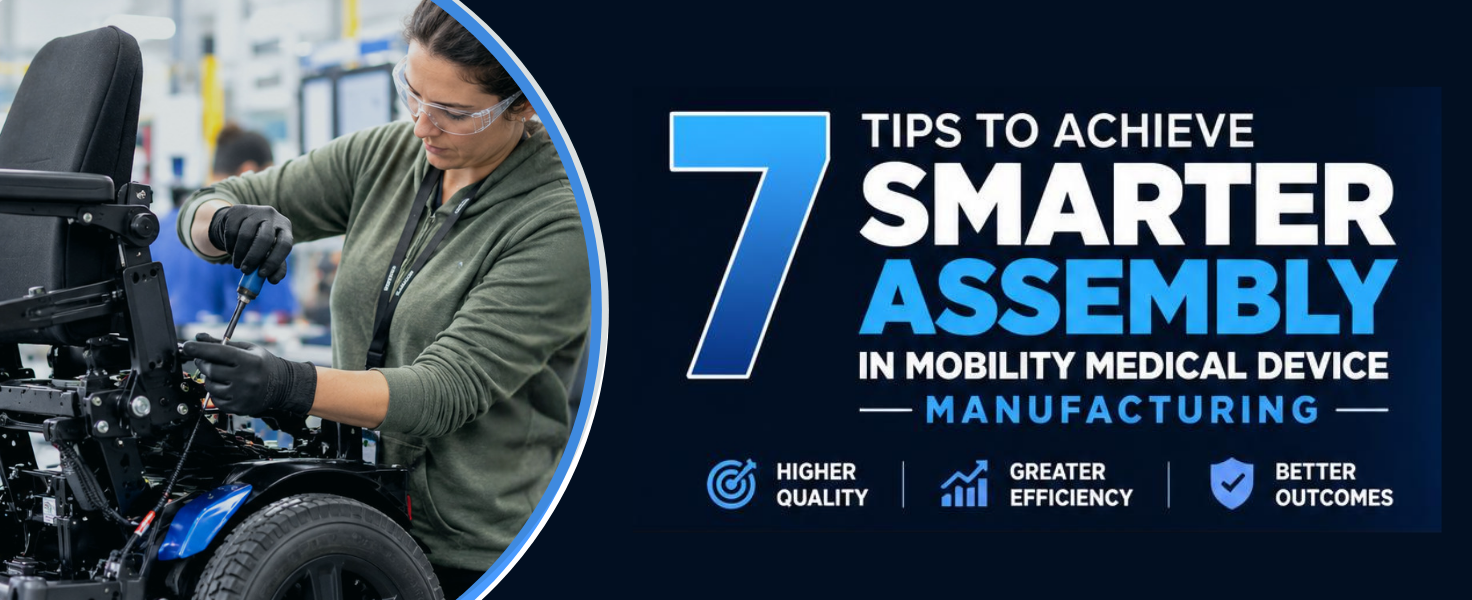
What if the fastest path to smarter mobility medical device assembly isn’t robotics … but instead better support for the people doing the work?
Complex assembly such as power chairs and scooters depends heavily on manual processes, workarounds, and employee knowledge. Industry 4.0 technologies can help mobility manufacturers achieve smarter, more reliable assembly while keeping people at the center of the process. See our case studies with Pride Mobility and Invacare America.
Don’t let your legacy systems and processes hold you back. Here are seven ways to get started.
1. Connect Your Manufacturing Processes, People, and Equipment.
When production depends on disconnected systems, spreadsheets, paper records, and manual updates, it can be difficult to know what is really happening on the plant floor.
A Manufacturing Execution System (MES) connects people, processes, and equipment to provide greater visibility and control over production.
For mobility medical device manufacturers, MES can help manage production flow, track products through assembly, and provide real-time information about what has been completed, what is in process, and where problems are occurring.
Smarter assembly starts with connected manufacturing.
2. Build Quality into the Assembly Process With Error-Proofing.
Error-proofing, or poka-yoke, helps prevent mistakes at the point of assembly. Digital systems can guide operators through the correct sequence, verify that the right components are being used, and require critical steps to be completed before production can continue.
For complex mobility products, error-proofing can reduce reliance on memory and tribal knowledge while helping operators consistently complete critical assembly steps.
Don’t just inspect for quality. Build quality into the process.
3. Give Operators the Right Information with Digital Work Instructions.
How do you transfer the knowledge of experienced employees to the next generation of workers?
Digital work instructions can help. Instead of relying on paper instructions or laminated cards that are difficult to keep current, operators receive clear, consistent guidance at the point of assembly. Digital instructions can provide visual guidance, process information, quality checks, and required actions.
The goal is to put the right expertise and information at the worker’s fingertips.
4. Use Manufacturing Data to Improve Visibility and Decisions.
Manufacturers generate enormous amounts of production data. The challenge is turning that data into useful information.
Manufacturing intelligence and visibility solutions can bring production information together to help teams understand performance and identify opportunities for improvement. Manufacturers can gain insight into areas such as:
- Production performance
- Cycle times
- Downtime
- Quality issues
- Rework
- Bottlenecks
- Process trends
This gives production and engineering teams a better understanding of what is happening on the floor—and why.
Better visibility leads to better manufacturing decisions.
5. Increase Throughput and Productivity with Line Balancing.
Mobility products can involve complex, variable assembly processes. When one operation takes significantly longer than another, work can begin to pile up. Line balancing helps distribute work more effectively across the assembly process, so production capacity is used more efficiently. This is especially important when manufacturers need to increase throughput without adding more labor.
Streamline the entire process for better flow, productivity, and consistency.
6. Make Compliance Part of the Digital Process.
Regulatory compliance is a critical part of medical device manufacturing. Manufacturers need to demonstrate that products were built according to defined processes and that required information was captured and retained.
Digital manufacturing systems can help enforce required actions, capture production data, and create electronic records as work is performed. That gives manufacturers greater control over the process while creating the information needed to support compliance.
When compliance is built into the process, it’s not an extra step at the end.
7. Focus on Preventing Warranty Problems and Protecting Your Brand.
For mobility products, quality and reliability are particularly important. Customers depend on these products every day. That makes preventing problems at the source one of the most effective ways to reduce downstream costs and protect the brand.
Digital work instructions, error-proofing, quality management, traceability, and production visibility can work together to identify problems earlier and help manufacturers understand exactly what happened.
The best warranty problem is the one that never leaves the factory.
In summary, mobility medical device manufacturers don’t have to choose between people and technology. The strongest manufacturing operations bring the two together. Industry 4.0 technologies can create a smarter, more connected assembly environment—one that helps workers succeed while giving manufacturers greater control over throughput, quality and compliance.
Ready to explore how Industry 4.0 can improve your complex assembly operations? Contact Matrix Automation to start the conversation.