

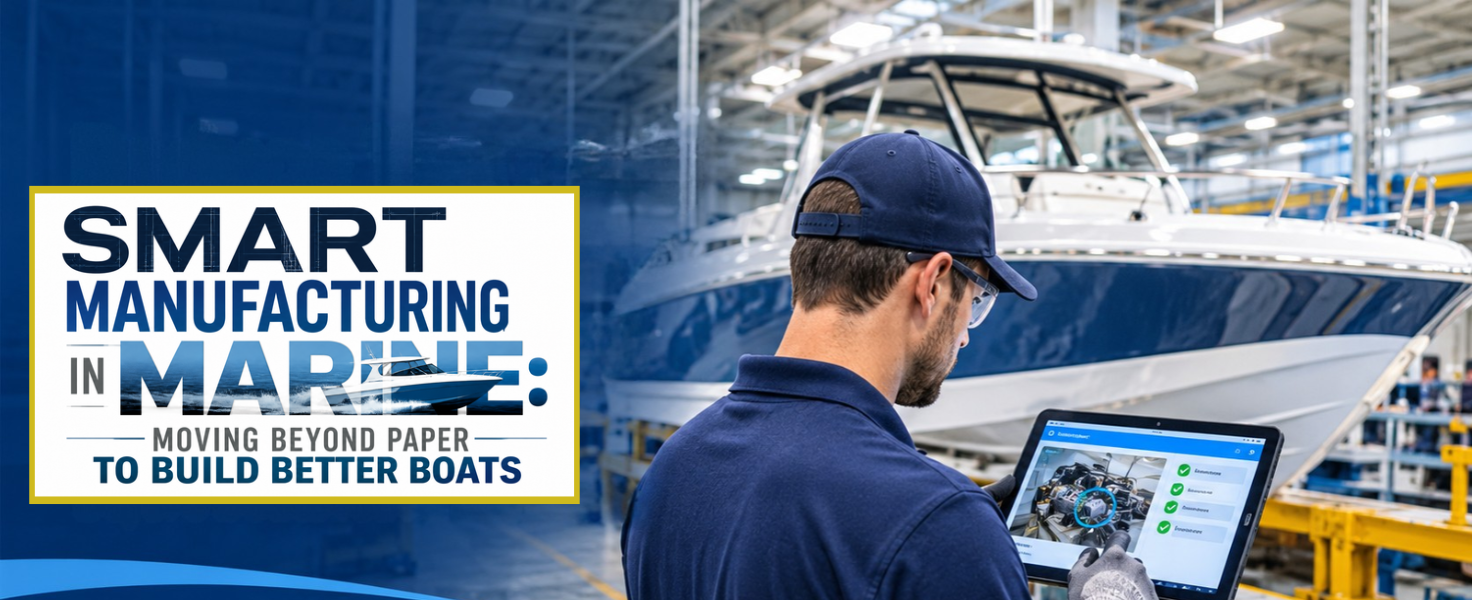
Recently, I met with a recreational boat manufacturer that has been building quality boats for decades. Its production floor is staffed by experienced technicians who know their jobs inside and out. Work instructions are printed, laminated, and posted at each station. Build sheets travel with each boat. When engineering makes a change, someone (usually) updates the paperwork and distributes new copies.
It works. But it’s getting harder.
Many of the most experienced employees are approaching retirement, taking years of hands-on knowledge with them. New employees need more time to learn complex assembly processes. Custom orders create additional paperwork and opportunities for mistakes. And when a quality issue surfaces, tracking down what happened can mean searching through binders, checklists, and employee recollections.
Management knows things need to change. But where do you start?
This scenario is not unique to this manufacturer. Across marine manufacturing, companies are facing an opportunity to modernize production processes without losing the craftsmanship that makes their products special. That’s where smart manufacturing comes in.
What Does Smart Manufacturing Mean for Marine?
Smart manufacturing connects people, processes, and equipment through digital technology. It gives manufacturers better visibility into production, more control over quality, and better information for making decisions.
For recreational boat manufacturers, smart manufacturing doesn’t mean automating every assembly task or replacing skilled workers. It means giving those workers better tools and information to do their jobs.
Several technologies can make a meaningful difference:
Digital Work Instructions: Replace printed instructions and build sheets with interactive, step-by-step guidance on tablets or at stations. Instructions can include images, assembly details, and configuration-specific requirements. Updates can be made available to the production team without redistributing paper.
Error-Proofing: Build verification into assembly processes to prevent mistakes before they move downstream. Confirm the correct components are installed, critical steps are completed, and quality checks are performed.
Manufacturing Execution Systems (MES): Connect production activities and capture information as work happens. It doesn’t have to be a heavy list to getting to tracking each boat by serial number, recording completed operations, and maintaining a digital history of the build.
Production Visibility: Use real-time production information to understand what’s happening across the plant. Identify bottlenecks, monitor quality, and recognize opportunities to improve processes.
Together, these example capabilities create a stronger digital foundation for manufacturing.
Why Marine Manufacturers Should Pay Attention
Boat manufacturing has unique challenges. Production is highly manual, products are often customized, and assembly involves many different disciplines, from electrical and plumbing to mechanical installation and finishing. Paper-based processes make it difficult to manage that complexity consistently.
Digitization can help manufacturers:
- Preserve workforce knowledge: Capture experienced employees’ best practices in standardized digital instructions
- Reduce assembly errors: Guide operators through complex tasks and verify critical steps
- Manage customization: Deliver the correct instructions and components for each boat’s configuration
- Improve quality: Identify problems during assembly rather than after delivery
- Increase traceability: Maintain production records that help investigate quality and warranty issues
- Improve efficiency: Reduce time spent searching for information, correcting mistakes, and managing paperwork
Smart manufacturing also helps manufacturers prepare for workforce changes. Digital guidance makes it easier to train new employees and maintain consistent processes as experienced workers retire.
Getting Started: Start with the Process, Not the Technology
Smart manufacturing doesn’t have to begin with a major investment or plant-wide transformation. In fact, starting small is often the better approach.
Begin by identifying a specific production process that creates recurring challenges. It might be electrical, helm assembly, engine installation, or final inspection.
Ask a few questions:
- Where do operators have a bottleneck?
- Which assembly steps generate the most rework?
- Where do mistakes or missed steps occur?
- Which processes depend heavily on one or two experienced employees?
- How difficult is it to track what was completed on an individual boat?
Choose one area where improving the process would deliver measurable value. Document the current workflow, identify opportunities to standardize the work, and introduce digital instructions and verification where they make sense.
Measure the results. Look at errors, rework, training time, and process consistency. Use what you learn to determine where to expand.
Once an initial project demonstrates value, manufacturers can develop a longer-term roadmap. The roadmap doesn’t need to happen all at once. Each step builds on the previous one, creating a foundation for further improvements.
Modernize Manufacturing Without Losing the Craftsmanship
Marine manufacturers don’t need to abandon the hands-on approach that defines boat building. They need to give their people better tools to support it.
Smart manufacturing helps preserve workforce knowledge, manage customization, improve quality, and reduce the errors and inefficiencies associated with legacy processes.
The goal is to bring the right digital capabilities to an industry where craftsmanship, flexibility, and quality matter.
The best place to start is often simple: replace paper with better information, guide the work, and build quality into every step.
Want to explore use cases to get started? Leverage our 40+ years of experience in complex assembly and smart manufacturing. Contact us for a consultation into digital innovation that can transform your operations.